Summary
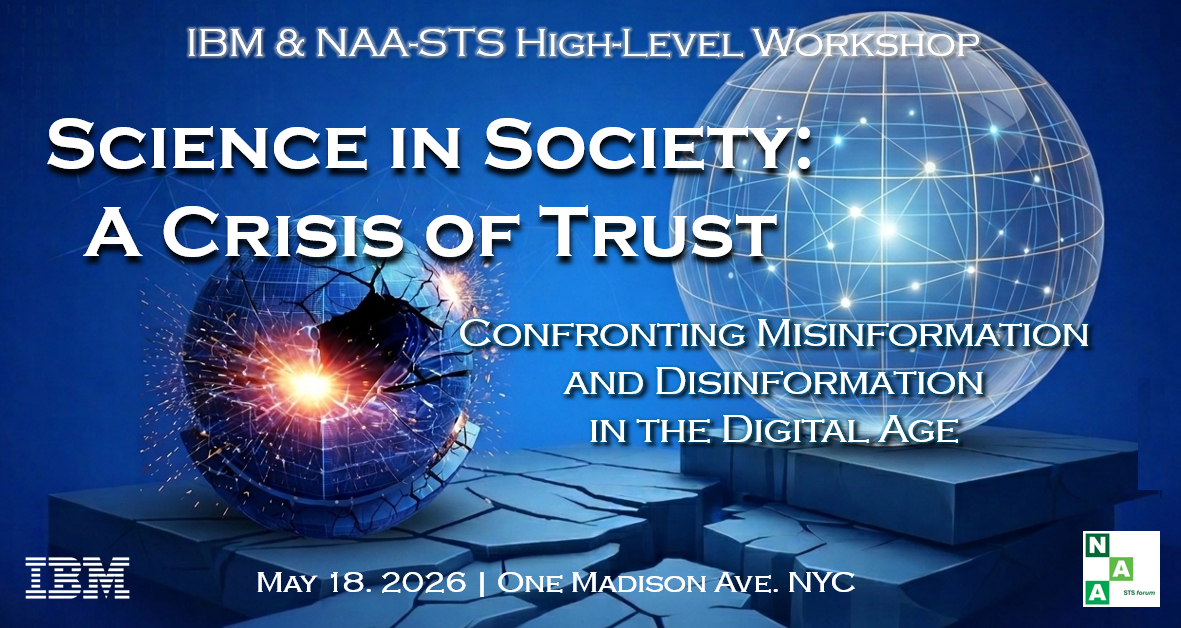
In recent years, the rapid expansion of digital platforms has transformed how information is created and shared, bringing both significant benefits and serious risks. The absence of effective curation has enabled misinformation and disinformation to spread widely, contributing to a growing crisis of trust in science and technology. Read more
In the past several years we have seen explosive growth in the use and misuse of digital "tools". Messaging applications have virtually supplanted face to face communication, while countless global digital platforms host and purvey vast troves of information. This explosion of access to information can be of great societal benefit, but a critical aspect of information acquisition and dissemination has been lost, that being curation. Digital platforms such as X, TikTok, and others, do not curate what is submitted. Once "information" is hosted, it is available to all on that platform. Curation is virtually non-existent other than for legal transgressions. Absent curation, information posted by those having no knowledge of a subject but a strong personal bias can be misleading at best, lethal at worst. Therein lies the challenge. How as scientists and technologists do we address the Crisis of Trust such behaviors have created. Diseases long absent from society such as measles have re-emerged at levels not seen for decades due to mis-information as to vaccine safety and efficacy. Studies known to be fraudulent are cited constantly online to discourage vaccinating children by reciting a long disavowed fraudulent study claiming that vaccines are associated with higher levels of autism in children. Perhaps more alarming, in the age of "AI for everyone", the ability to generate deep fakes to spread disinformation with intent to impugn someone's ethics or destroy a business is now readily available to all.
Being proactive, is it possible to establish means to create curated datastreams in real time so as to mitigate the aforementioned issues? How might one begin such an effort without the inevitable pushback over that being "censorship"? Could curation be launched at the governmental and regulatory level, or as a grass roots/startup driven effort? How can we rebuild trust through the use of technology to curate data, or must this be a human driven "hands-on" process unlikely to scale fast enough to address all issues in a timely manner? If effective, we then must ask ourselves who "owns" such an invaluable curated data asset gleaned from global data on the web. Is there "data sovereignty" allowing ownership of IP created?
The challenge before us is that the long standing "assumption" by the general public that data they receive is accurate and has been solidly vetted is now dangerously wrong, and false data provided by either intent or ignorance has caused a crisis of trust in science, one which we need to address immediately or face dire societal consequences. Whether we undertake the task of rebuilding trust using technology, personal engagement, or a combination of other approaches yet to be discovered, this is an issue we ignore at great societal peril.
Program
Leadership

Chair
Dr. Hank McKinnell

Moderator
Dr. Bernie Meyerson

STS forum
Amb. Sadayuki Tsuchiya
Panelists

Prof. Arthur Lupia

Dr. Chitkala Kalidas

Mr. David May
Discussion Questions
1. Given the many commercial platforms employed to disseminate information on a global scale, which would be your top three platforms to focus on with the goal of improving the integrity of information made available? Why have they been chosen?
2. Consider the challenge associated with determining what is accurate information as required to curate a given platform’s information base. What might be viable sources of “truth” to ensure that curated data reflects best knowledge available at any given time? How might one select such a source? Who, if anyone, should bear the responsibility of validating information as hosted on a commercial platform?
3. AI Large Language Models such as ChatGPT, Google’s Gemini, and a host of others, rely upon non-curated web-based data sources, ingesting all available digital content as the basis from which to draw conclusions and present those as answers to any given query. Is it even reasonable to attempt the validation of global web content to improve AI functionality? If this were to be attempted, who, if anyone, would own rights to the massive resultant “clean” data stream?
4. Does one have the ability or the right, to identify and penalize “bad actors” who consistently spread false and dangerous misinformation on the Web? Is this a local or global endeavor, perhaps with the creation of the digital variant of Interpol? How does one answer the objection as to this being censorship?
5. Can there be a set of standards developed to indicate the level of curation that a specific AI’s training data has been held to? What categories of quality might be feasible/acceptable, such as a minimal standard being that any materials deemed illegal have been eliminated, versus perhaps a “gold standard” asserting first-person/original source validation of all data contained in the data stream? Are there any suggestions as to how such a rating system might be developed and what criteria might be set and enforced?
Show moreDiscussion Chairs
|
Table 1: Dr. Ian Colrain Table 2: Mr. Chad Evans Table 3: Dr. Adam Falk Table 4: Ms. Ann Gabriel Table 5: Mr. Peter Halpin Table 6: Dr. Eric Isaacs Table 7: Dr. Michael Moloney Table 8: Dr. Caroline Montojo Table 9: Dr. Mark Peters Table 10: Dr. Padma Raghavan |
Supporters
2026 STS & NAA-STS Members from North America
|
|
See the list of all 84 members worldwide at the STS website
If you are interested in becoming a member, please contact the NAA-STS secretariat
2025 STS forum Annual Meeting Sponsors
Premium Sponsors


Lead Sponsors



Sponsors